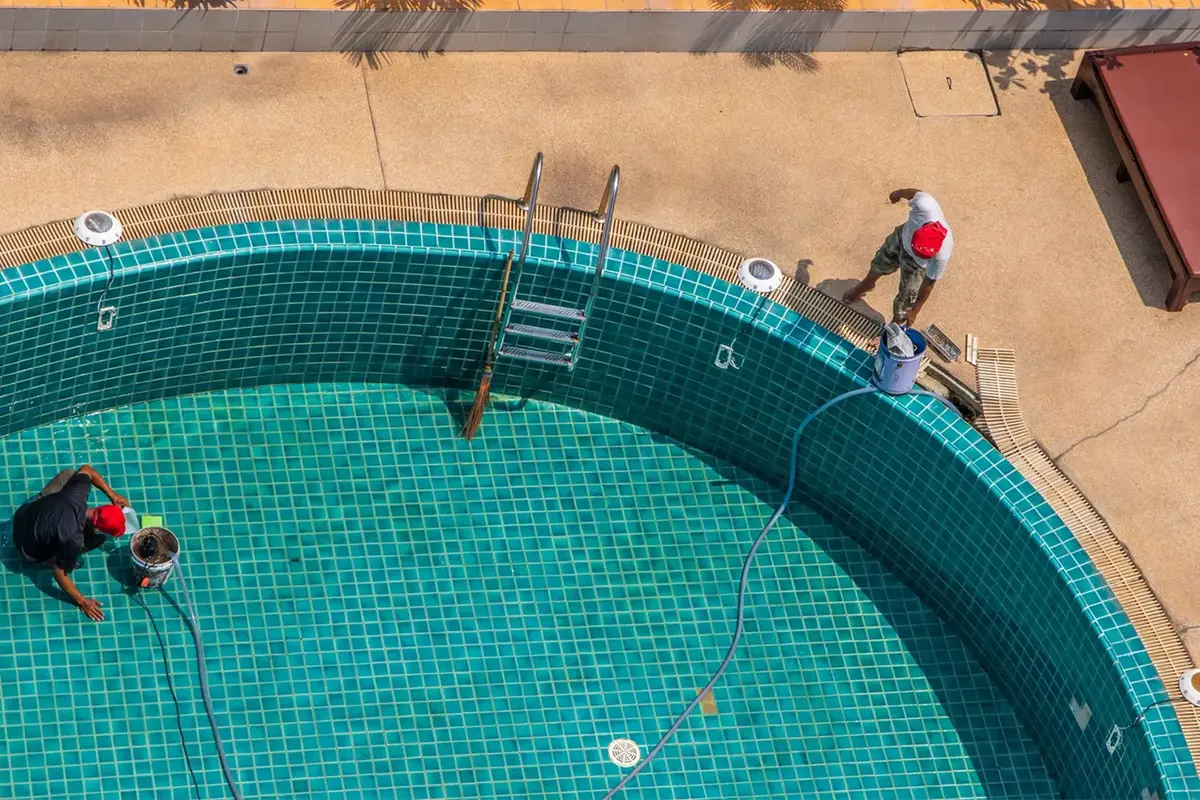



- Full pool deck replacement runs $15–$35 per square foot — a typical 900 sq ft deck lands between $13,500 and $31,500. Resurfacing a sound slab runs just $3–$8.
- The right choice lives below the surface: a stable slab can be resurfaced; settlement, full-depth cracks, or drainage failure mean replacement — coatings crack along the same lines.
- In coastal Florida, spalling and delamination usually trace back to salt-driven rebar corrosion. Patching the surface doesn't stop the reaction inside the concrete.
- Replacement takes one to three weeks of construction plus about 28 days for the concrete to reach full cure; resurfacing takes days.
- Elevated pool decks over parking garages or amenity levels are structural projects — waterproofing membrane, engineer, permits — not landscaping.
In This Article
Every pool deck reaches a decision point. Cracks spread, sections settle, the surface fades — and somebody has to decide whether to patch it, coat it, or tear it out and start over. The wrong call gets expensive in both directions: replace a deck that only needed resurfacing and you overspend by thousands; put a coating over a failing slab and you'll pay to redo everything within a couple of years.
This guide gives you a straight answer. We'll cover how to tell repair from replacement, what pool deck replacement actually costs, how the process works step by step, and the situations — common in South Florida — where the deck around your pool is really a structural project in disguise. New Age Construction Group handles pool deck repair and restoration across Miami-Dade, Broward, and Palm Beach counties, and the honest truth is that not every deck we look at needs to be replaced. Here's how to know which side of the line yours is on.
Repair, Resurface, or Replace? How to Make the Call
There are three tiers of pool deck work, and the right one depends on the condition of the concrete slab underneath — not on how the surface looks.
When repair or resurfacing is enough
If the slab is structurally sound, you have options short of demolition. Isolated cracks can be routed, filled, and sealed. A settled section can sometimes be lifted on its own. And if the deck is solid but worn, faded, or slippery, pool deck resurfacing — a polymer-modified concrete coating or overlay applied over the existing slab — restores the surface for a fraction of replacement cost. Resurfacing your pool deck also lets you add a slip-resistant texture and a lighter color that stays cooler underfoot, which is why it's the workhorse of most pool remodeling projects.
A deck is a resurfacing candidate when cracks are hairline and stable, the surface drains properly, and nothing is moving. Stamped concrete overlays, stained concrete, and acrylic concrete coatings all fall in this tier.
When only replacement solves it
Replacement is the answer when the problem lives below the surface. A concrete coating is a finish, not a repair — applied over a moving or deteriorating slab, it simply cracks along the same lines. If your deck shows structural settlement, widespread deep cracking, crumbling concrete, or drainage that sends water toward the building, the slab itself has failed, and everything installed on top of it fails with it.
Signs Your Pool Deck Needs Full Replacement
A few symptoms reliably separate cosmetic wear from structural failure.
Structural cracks and settlement. Hairline surface cracks are normal concrete behavior. Cracks that run through the full depth of the slab, open and close with the seasons, or step up into a trip hazard are not. The same goes for heaving and settlement — when whole sections sit an inch high or low, the sub-base (the compacted ground beneath the concrete) has eroded or shifted, and no overlay fixes that.
Spalling and delamination. Spalling is concrete flaking or breaking away from the surface, often exposing the aggregate — or worse, the steel — beneath. Delamination is a layer of concrete separating from the layer below it, and it often announces itself with a hollow sound underfoot before anything visible appears. Around a pool in coastal Florida, both are frequently symptoms of rebar corrosion: salt air and pool chemicals reach the reinforcing steel, the steel rusts and expands, and it pushes the concrete apart from the inside. Patching the surface doesn't stop the reaction that caused it.
Drainage failure. Water should shed away from the pool and the structure. If it ponds on the deck or flows toward the building, the slab was poured at the wrong slope or has settled into one. You cannot fix a bad slope with a thin coating — the deck has to be removed and re-graded.
Warning signs on elevated decks. If your pool sits above a parking garage, lobby, or amenity level, take leaks, rust stains, or cracking on the ceiling below the deck seriously. Those are signs the waterproofing membrane under the deck surface has failed — a different and more urgent problem than worn decking, and one we cover later in this guide.
A hollow sound underfoot is often the first sign of delamination — the damage announces itself by ear before anything shows on the surface. If tapping your deck sounds hollow, get a structural assessment before coating anything.
What Pool Deck Replacement Costs
Full pool deck replacement typically runs $15 to $35 per square foot, covering demolition, haul-away, sub-base preparation, reinforcement, the new concrete pour, and a standard finish. For a typical 900-square-foot residential deck, that's roughly $13,500 to $31,500. Partial replacement of failed sections runs about $8 to $15 per square foot, and resurfacing a sound slab runs $3 to $8 — which is exactly why the repair-or-replace diagnosis matters before anyone quotes you a number.
| Scope | What's Included | Typical Cost |
|---|---|---|
| Resurfacing | Surface prep, crack repair, overlay or coating, sealing | $3–$8 / sq ft |
| Partial replacement | Demolish failed sections, sub-base repair, matching pour | $8–$15 / sq ft |
| Full replacement | Demolition, haul-away, sub-base, reinforcement, new pour, finish | $15–$35 / sq ft |
Two line items surprise people. Removal alone costs $2 to $6 per square foot before any new work begins, and premium deck materials add quickly: brick pavers run roughly $10 to $30 per square foot installed, and natural stone like travertine or flagstone can reach $45.
What drives the price up
The expensive part of a replacement usually isn't the finish you can see — it's what has to happen underneath. Rebuilding a failed sub-base, correcting drainage with re-grading or new deck drains, difficult site access, and disposal fees move the number more than the choice between gray and colored concrete. On elevated structural decks, waterproofing and concrete repair are their own scope entirely. Get every bid itemized so you can compare repair, resurfacing, and replacement as separate line items.
The Pool Deck Replacement Process, Step by Step
A properly run replacement follows the same sequence whether it's a backyard deck or a commercial amenity deck.
Assessment
A qualified contractor inspects slab condition, slope, drainage, and the sub-base, and confirms replacement is actually warranted.
Permitting
In South Florida, replacing a pool deck generally requires a permit — more on that below.
Demolition
The old deck is saw-cut, broken out, and hauled away. Expect noise and concrete dust for a few days.
Sub-base and structural repair
Fresh aggregate is placed and compacted, grades are corrected so water sheds away from the pool and building, and — on structural decks — damaged concrete and corroded reinforcing steel are repaired before anything new goes down. This is also the cheapest moment you'll ever have to fix what's behind or beneath the deck, from plumbing lines to failing pool walls, because everything is already open.
Reinforcement and the new pour
Forms and steel go in, concrete is poured and finished, and control joints and expansion joints are cut and sealed to manage future movement.
Waterproofing, sealing, and cure
Elevated decks get a new waterproofing membrane; on-grade decks get a penetrating sealer. Concrete takes about 28 days to reach full cure, though the deck typically handles foot traffic much sooner.
Start to finish, plan on one to three weeks of construction for a full tear-out, compared to a few days for resurfacing.
Choosing the New Surface
Replacement is the one chance to rethink the whole outdoor space rather than recreate what was there.
Concrete finishes. A broom-finished concrete pool deck is the most economical choice, with dependable grip when wet. Colored and stamped concrete add pattern and custom design without changing the structure, exposed aggregate adds texture underfoot, and lighter tones absorb less heat.
Pavers and natural stone. A paver deck — concrete pavers, brick, travertine, or flagstone — costs more but allows individual pieces to be lifted and reset if anything ever settles, which keeps long-term maintenance simple. Tumbled travertine stays comfortable underfoot and gives condo amenity decks and connected walkways a finish that reads as an upgrade, not a repair.
Slip resistance and heat. Whatever the material, specify a slip-resistant texture and a light color — on the deck itself and on the walkways leading to it. A pool deck is a wet walking surface in a hot climate; safety and bare-foot comfort outrank looks, and the good news is you no longer have to choose between them.
Match the coping — the cap where deck meets pool — and the expansion joint between coping and deck to the new surface, and keep that joint caulked. Along with resealing every few years, it's the small maintenance habit that keeps water out from under your new deck.
Elevated and Rooftop Pool Decks Are a Different Project
Everything above describes a deck poured on grade. But across South Florida, thousands of pools sit on elevated structural slabs — above parking garages, amenity levels, and occupied floors. On those buildings, the pool deck is also the roof of the space below it, and replacing it is structural work, not landscaping.
An elevated pool deck replacement means removing the topping and finishes down to the structural slab, repairing spalling or delaminated concrete and corroded reinforcement, installing a new waterproofing membrane, and rebuilding the wearing surface above it — often with a structural engineer designing the repairs and inspecting the work. Deck failures here rarely start at the surface; they start with a failed membrane letting water reach the structure. That's why leaks below the deck matter more than cracks on top of it.
This is the scope most pool deck contractors and coating companies aren't licensed or equipped to touch, and it's the core of what New Age does as a structural concrete restoration contractor. If your building is a condominium, the deck condition may also surface in your milestone inspection or 40-year recertification — for boards, pairing deck replacement with those repairs is usually the most cost-effective path, since mobilization, permitting, and engineering are already in motion.
Replacing a Pool Deck in South Florida
Three local realities shape pool renovations here.
Salt air and water intrusion. Coastal humidity and salt accelerate rebar corrosion, which is why South Florida decks spall sooner than the national average. Whatever you build, waterproofing and sealing aren't optional extras — they're what determines how long the new deck lasts.
Permits and inspections. Miami-Dade, Broward, and Palm Beach counties treat pool deck replacement as permitted work, with drainage and safety requirements reviewed at inspection. On commercial and condo association properties, expect engineering drawings as part of the submittal. A licensed general contractor carries this process; an unlicensed installer leaves it — and the liability — with you.
Timing. The summer rainy season complicates concrete pours and cure schedules. Boards and property managers planning an amenity deck project get better pricing and cleaner schedules booking demolition for the drier months, with the deck back in service before peak season.
Get a Straight Answer Before You Spend
The difference between a $6-per-foot resurfacing job and a $30-per-foot replacement is a diagnosis — and it should come from a contractor with no reason to steer you toward either. New Age Construction Group is a state-certified general contractor (CGC #1531273) specializing in structural restoration and pool deck repair for condominiums, commercial properties, and homes across Miami-Dade, Broward, and Palm Beach counties. We'll assess the slab, tell you plainly whether repair, resurfacing, or replacement makes sense, and put the numbers in writing.
Call (786) 786-1006 or request a free assessment online — before small cracks become a structural project.
- 1Get the slab diagnosed before you accept any quote — the difference between $3–$8 and $15–$35 per square foot is a diagnosis, not a preference.
- 2Check the four replacement signs: full-depth or seasonal cracks, settlement and heaving, spalling or hollow-sounding delamination, and water draining toward the building.
- 3Budget from the ground down — sub-base repair, drainage correction, haul-away, and site access move the price more than the finish you choose.
- 4If you replace, fix everything beneath the deck while it's open: drainage, plumbing, and structural repairs are never cheaper than at that moment.
- 5In Miami-Dade, Broward, and Palm Beach, run the project through a licensed GC who carries the permits — and on elevated decks, require a waterproofing membrane and engineer sign-off.

Stephanie Lopez
Owner, New Age Construction Group
Stephanie Lopez is the owner of New Age Construction Group, a state-licensed structural restoration contractor (CGC#1531273) serving Miami-Dade, Broward, and Palm Beach County. She leads the firm's concrete restoration, waterproofing, post-tensioning, and 40-year recertification work for condominiums, HOAs, and commercial properties across South Florida.
View Full Profile →