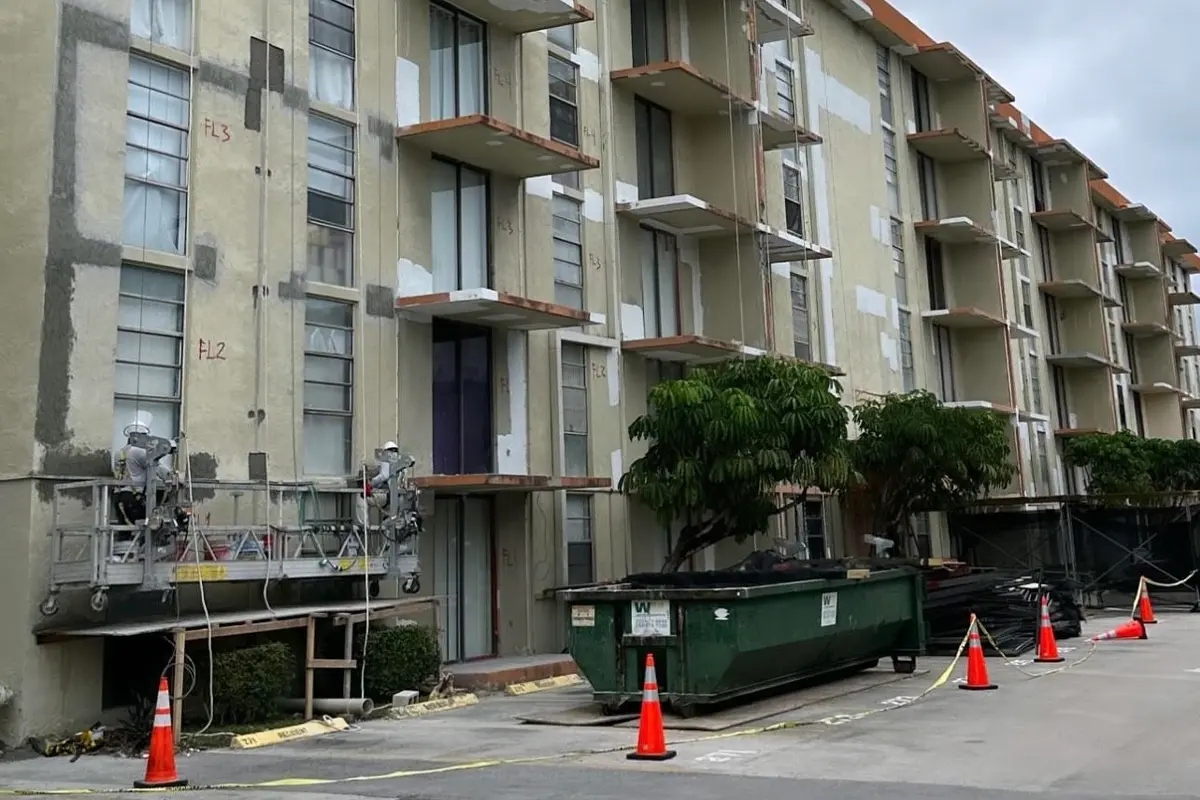



- Concrete scaling is the flaking or peeling of the thin top layer of surface mortar — shallow, and usually cosmetic. Concrete spalling is deeper: chunks breaking away, often exposing aggregate or steel, and potentially structural.
- Three field tests settle it: the flake test (credit-card-thin flakes = scaling; thick chunks = spalling), the tap test (a hollow, drummy sound = delamination — the hidden stage before a spall), and rust stains or straight-line damage = corroding steel below.
- Forget the freeze-thaw explanation you'll read everywhere — South Florida concrete never freezes. Here, scaling is almost always a finishing/curing/workmanship story, and spalling is a chloride corrosion story: salt air, water intrusion, and concrete age.
- Severity is the real difference. Scaling on a young slab is worth documenting while a warranty applies; spalling on balconies, columns, or parking garages is the structural red flag milestone and 40-year inspectors look for.
- Repair the mechanism, not the symptom: scaling gets resurfacing and a sealer; spalling needs structural restoration that treats the steel — cosmetic patches over corroding rebar fail at the edges within a few years.
In This Article
Concrete scaling and concrete spalling look similar from a few feet away — both leave you with a crumbling, deteriorating surface — but they are different problems with different causes, and only one of them is a structural warning sign. If you manage a condo, commercial property, or home in Miami-Dade, Broward, or Palm Beach County, telling them apart decides whether you're looking at a cosmetic fix or the first visible sign of a problem an inspector will flag.
Here's the complication: almost everything written about concrete scaling vs spalling was written for northern climates. This guide explains both defects, how to tell which one you have in three quick field tests, and why the causes — and the stakes — are different in South Florida.
What Is Concrete Scaling?
Scaling is surface flaking — the outermost skin of a concrete slab detaches in thin scales, starting as small patches that spread and merge. As the surface mortar peels away, the fine sand underneath shows through and the slab takes on a rough, pitted texture.
Scaling lives in the top fraction of an inch: the damage is shallow, the concrete underneath is still sound, and no steel is exposed. It's most common on pool decks, sidewalks, patios, and slabs that were finished or cured poorly — and it tends to show up in the first year or two of a slab's life.
What Is Concrete Spalling?
Spalling is deeper and more serious — chunks of concrete break off, leaving defined divots that expose the coarse aggregate and, in advanced cases, bare steel. Rust stains bleeding through the surface, or damage following straight lines (tracking the reinforcement below), are classic signs corrosion is driving the damage from inside.
In coastal Florida, spalling is the defect that shows up on balconies, parking garages, columns, and facades — and it's the visible symptom inspectors look for. Our guide to spalling concrete in South Florida covers the mechanics in depth: when embedded steel rusts, it expands, and the internal pressure blows the concrete cover off.
Scaling vs. Spalling Side by Side
| Scaling | Spalling | |
|---|---|---|
| What it is | Thin flaking/peeling of the surface mortar | Chunks or layers breaking away from deeper in the slab |
| Depth | Shallow — the top skin | Deeper — can extend to the rebar |
| What you see | Rough, pitted patches; fine aggregate exposed; thin scales | Divots and craters; exposed stone or steel; rust staining |
| Main causes here | Finishing and curing defects, weak surface paste | Chloride-driven rebar corrosion, water intrusion, carbonation |
| Severity | Usually cosmetic | Potentially structural — the inspection red flag |
| Typical fix | Cleaning, resurfacing, sealing | Structural concrete repair: remove, treat steel, rebuild |
How to Tell Which One You're Looking At
Three quick field checks will usually settle it:
The Flake Test
Look at what's coming off. Thin scales of surface skin — flakes you could almost slide a credit card under — mean scaling. Thick chunks exposing stones or steel mean spalling.
The Tap Test
Tap around the damage with a hammer. Sound concrete rings sharp; a dull, hollow, drummy sound means delamination — a layer separated below an intact-looking surface. Today's hollow spot is tomorrow's spall.
Rust & Lines
Rust stains around the damage, or damage running in straight lines, point to corroding steel underneath. That means spalling — and an active corrosion problem patching alone won't stop.
Large hollow-sounding areas are worth a professional look even if nothing has broken off yet.
What Causes Scaling and Spalling in South Florida?
Why the freeze-thaw explanation doesn't apply here
Almost every article — and most AI summaries — blames freeze-thaw cycles and deicing salts: water freezes in the pores, expands, and pops the surface off. That's true in Chicago. It's also why northern specs call for air-entrained concrete. In Miami-Dade, Broward, and Palm Beach County, slabs essentially never freeze and nobody salts a driveway — so the textbook causes are the wrong suspects, and the real ones tell you more.
Reading advice written for northern climates will point you at the wrong repair.
Freeze-thaw scaling is a surface durability problem; South Florida spalling is usually an active corrosion problem. The first calls for a sealer. The second calls for treating the steel.
What actually causes scaling here
With freeze-thaw off the table, scaling here is almost always a construction-quality story: finishing defects (troweling while bleed water is rising traps water under a weak, paste-rich skin), curing problems (concrete drying too fast in our heat never develops full surface strength), a weak concrete mix or high water-cement ratio at the surface, and coastal salt crystallization slowly chewing at slabs near the ocean. The practical upshot: scaling on a young slab is usually a workmanship signature, not weather damage — which matters if the pour is still under warranty.
What actually causes spalling here
Spalling in coastal Florida is a corrosion story: salt air carries chlorides through porous concrete until they reach the rebar and rust begins — rust swells to several times the steel's volume ("oxide jacking"), cracking the concrete cover from inside. Water intrusion through failed waterproofing delivers moisture and chlorides straight to the steel. Carbonation slowly neutralizes concrete's protective alkalinity over decades — a big reason 1970s–80s buildings are spalling now. And cover/placement defects (steel set too close to the surface, voids from poor consolidation) shortcut the whole process.
Which One Is Serious?
This is the question behind the question — and the honest answer has two halves.
Scaling — usually cosmetic
It looks bad and can admit more water over time, but rarely threatens the slab. Two honest caveats: on a new pour it may signal a finishing or mix defect worth documenting while a warranty applies, and scaling that keeps spreading is an invitation for deeper moisture problems.
Spalling — the structural red flag
On a driveway it may only be ugly; on a balcony, column, elevated walkway, or parking garage it means the concrete cover protecting the steel is failing — and with it, eventually, load-bearing capacity. Corrosion keeps expanding, delamination spreads, and repair scope grows every year. Exposed steel overhead is a falling-debris hazard as well as a structural one.
If you're not sure which you have — or the tap test finds widespread hollow areas — have a licensed contractor or structural engineer assess it before deciding anything.
How Each Problem Is Repaired
Scaling repair is a surface operation: the weak, scaled layer is cleaned off (grinding or pressure-washing), the surface is renewed by resurfacing — a polymer-modified topping or concrete overlays bonded to the sound slab — then protected with a penetrating sealer. For minor, stable scaling, sealing alone may be enough; a simple patching compound handles isolated spots.
Spalling repair done right is structural work, and this is where quick fixes fail. Mortar slapped over a spall without treating the steel traps the corrosion inside — and often accelerates rusting at the patch edges (the "ring-anode" effect), so the repair pops out within a few years. Proper concrete restoration removes all delaminated and unsound concrete, cleans and treats the exposed rebar (or replaces steel that has lost too much section), applies corrosion protection and bonding agents, and rebuilds the profile with engineered repair mortars. On post-tensioned or heavily damaged structures, that work belongs under engineering supervision and permits.
What This Means for South Florida Condos and Commercial Buildings
For condo associations and property managers, the scaling-vs-spalling distinction has a compliance dimension. Florida's milestone inspection law (SB-4D) requires structural inspections for condo and co-op buildings three stories or taller — first at 30 years (25 near the coast), then every 10 years after. In Miami-Dade and Broward, the 40-year recertification applies to most other buildings. Spalling, rust staining, and delamination are precisely the surface issues these inspections are designed to catch — and documented, engineered repairs are what satisfy them.
A board that addresses spalling when it's a few balcony corners is in a very different budget conversation than one that waits for an inspector's report. Fixing it on your own schedule is almost always cheaper than fixing it on an examiner's.
Preventing Both in a Coastal Climate
Prevention here isn't about winter — it's about keeping water and chlorides out of the concrete:
- Maintain waterproofing membranes, protective coatings, and sealants on balconies, roofs, and garage decks
- Apply penetrating sealers on exposed slabs every few years — cheap insurance against chloride penetration
- Fix drainage so water never ponds on concrete
- Seal cracks promptly; every crack is a chloride expressway to the steel
- Put aging buildings on a scheduled inspection and maintenance program instead of waiting for chipping concrete to force the issue
- 1Depth decides everything: scaling lives in the top skin of surface mortar; spalling extends toward the steel — that's the difference between a cosmetic fix and a structural repair.
- 2In South Florida, ignore the freeze-thaw advice: scaling here is a workmanship signature (finishing, curing, mix), while spalling is chloride-driven rebar corrosion from salt air, water intrusion, and age.
- 3Three field tests tell you which one you have: flake thickness (thin = scaling), the hammer tap test (hollow = delamination, the hidden stage before a spall), and rust stains or straight-line damage (= corroding steel).
- 4Scaling is usually cosmetic — but document it early on a new pour while a warranty applies. Spalling on balconies, columns, or garages is the red flag milestone and 40-year inspections are designed to catch.
- 5Repair the mechanism, not the symptom: resurfacing and sealing for scaling; engineered restoration that treats the steel for spalling — patches over corroding rebar fail at the edges within a few years.

Stephanie Lopez
Owner, New Age Construction Group
Stephanie Lopez is the owner of New Age Construction Group, a state-licensed structural restoration contractor (CGC#1531273) serving Miami-Dade, Broward, and Palm Beach County. She leads the firm's concrete restoration, waterproofing, post-tensioning, and 40-year recertification work for condominiums, HOAs, and commercial properties across South Florida.
View Full Profile →Frequently Asked Questions
Seeing flaking or spalling concrete on your property? New Age Construction Group is a state-certified general contractor (CGC #1531273), insured and bonded, specializing in structural restoration across Miami-Dade, Broward, and Palm Beach County. We'll tell you honestly whether you're looking at a cosmetic surface issue or a structural one — and engineer the repair to match.