



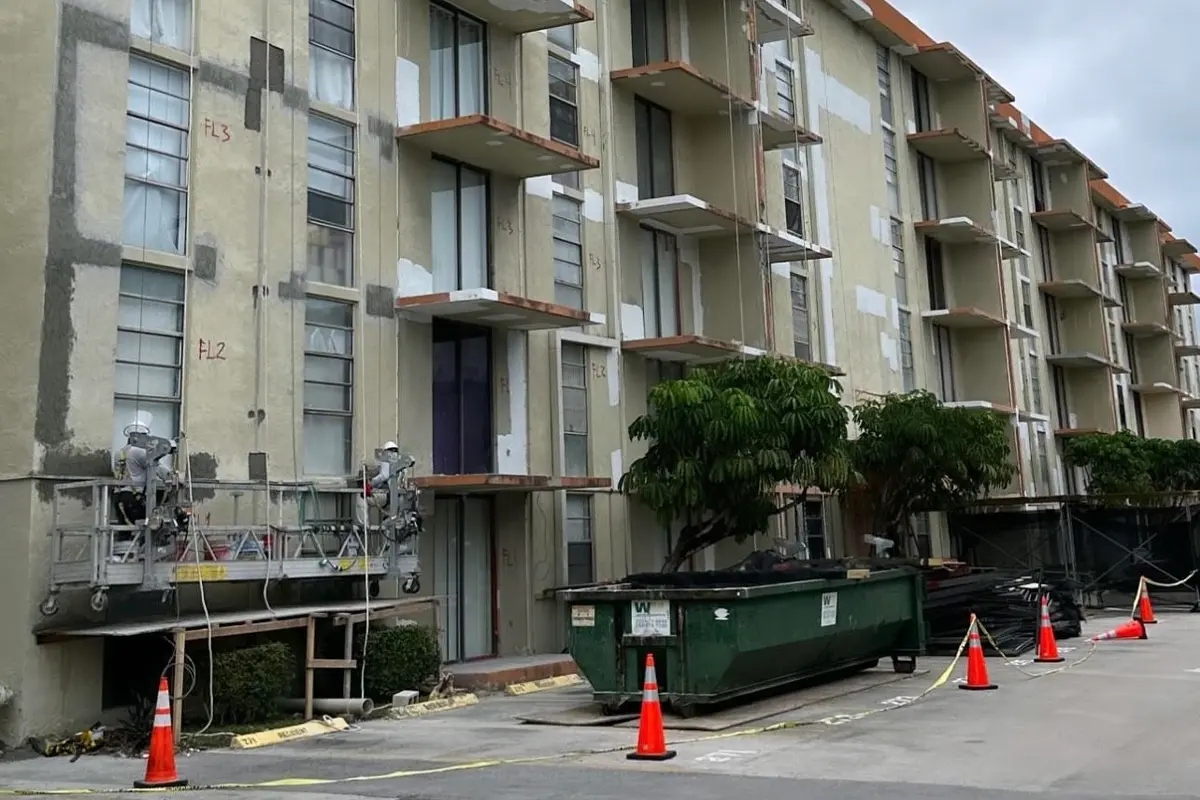
- Concrete cancer is the everyday name for concrete that is breaking down from the inside.
- In Australia, the UK and coastal Florida, the phrase almost always means rusting reinforcement and the concrete spalling that follows.
- In coastal Florida, the main driver is chloride.
- Rust-related damage is repaired every day. ASR is harder and is usually managed.
- Patching over rusted bars without treating the steel is not remediation.
In This Article
Concrete cancer is the everyday name for concrete that is breaking down from the inside. The damage starts below the surface, spreads quietly, and shows itself only after cracks, rust stains or loose chunks appear. The confusing part is that the term describes two different problems. In one, the reinforcing steel inside the concrete rusts. In the other, a chemical reaction within the concrete itself causes it to swell and crack. This guide explains both, shows how to tell them apart, and walks through diagnosis and repair in South Florida buildings.
What Is Concrete Cancer?
Concrete cancer is progressive deterioration that begins inside a concrete element and works its way out. It is not an engineering term. Engineers name the specific mechanism, because the mechanism decides the repair.
Why the Term Covers Two Different Problems
In Australia, the UK and coastal Florida, the phrase almost always means rusting reinforcement and the concrete spalling that follows. In recent US news coverage, it usually means alkali-silica reaction, or ASR, after thousands of swimming pools in Texas began cracking. Several popular articles blend the two into one explanation, which is inaccurate. They have different causes, different warning signs and very different repair options.
The Two Types of Concrete Cancer
Rebar Corrosion and Spalling
Concrete is strong in compression and weak in tension, so builders embed steel reinforcing bars (rebar) to carry tensile loads. Fresh concrete is highly alkaline, and that alkalinity forms a thin protective film around the steel. When salt or carbon dioxide works through the concrete cover, which is the layer of concrete between the steel and the outside face, that film breaks down and the steel starts to rust.
Rust takes up several times the volume of the steel it replaces. The expansion pushes outward until the concrete cracks, separates in sheets (delamination) and eventually breaks away. That last stage is spalling concrete. Each new crack lets in more water and salt, so the cycle speeds up. That self-feeding spread is where the "cancer" label comes from.
Alkali-Silica Reaction (ASR)
This second type involves no steel at all. It is a chemical reaction between the alkalis in cement and certain forms of silica found in some sand and stone aggregate. The reaction produces a gel. When the gel absorbs moisture, it swells, and the internal stress cracks the concrete from within, often in a web or map pattern with white residue at the cracks.
It depends on the mix. It needs reactive aggregate, enough alkali and a steady supply of water. Supplementary materials such as fly ash are commonly added to a mix to suppress it.
Side by Side Comparison
| Steel corrosion | ASR | |
|---|---|---|
| Root cause | Salt or carbonation reaches the reinforcing steel | Reactive aggregate plus alkalis plus moisture |
| Where it shows up | Balconies, columns, walls, garage slabs, pool decks, facades | Pool shells, slabs, pavements, dams, foundations |
| Typical look | Brown staining, cracks that follow the bar lines, hollow sounding areas, exposed bars | Map cracking, white or clear gel, misaligned surfaces |
| Timeline | Often decades, faster near the ocean | Commonly a few years after the pour |
| Can it be repaired? | Yes, routinely | Managed, not cured |
A third and rarer mechanism, sulfate attack, is sometimes placed under the same label.
What Causes Concrete Cancer?
Chlorides and Salt Air
In coastal Florida, the main driver is chloride. Salt air settles on every exposed surface, dissolves in rain and humidity, and soaks into the concrete's pores. Once enough chloride reaches the bars, rusting starts even in concrete that looks perfect from the outside.
Carbonation and Water Intrusion
Carbon dioxide slowly lowers the alkalinity of concrete from the surface inward, a process called carbonation. If the concrete cover is thin, the carbonated zone reaches the steel sooner. Failed waterproofing, ponding water, unsealed cracks and leaking planters all shorten the timeline by keeping the concrete wet.
Reactive Aggregates and Weak Mix Design
This type traces back to what went into the truck. KXAN in Austin reported in July 2026 that experts estimate as many as 30,000 Central Texas pools may be affected, and tied the outbreak partly to a regional shortage of fly ash. The Central Texas pools made national headlines, but the same chemistry can occur anywhere a reactive aggregate meets a high-alkali mix.
What Are the Signs of Concrete Cancer?
Signs on Buildings, Balconies and Parking Garages
- Rust stains and concrete spalling showing through paint, stucco or a slab's underside
- Cracks running in straight lines that follow the reinforcing steel
- Bubbling or bulging stucco and paint
- Concrete that sounds hollow when tapped
- Flaking or fallen pieces, with or without exposed bars
- Leaks and white mineral deposits on ceilings below balconies or decks
Signs in Pools and Pool Decks
On a pool deck, rust spots, lifting coatings and cracks near drains or railing posts usually point to deteriorating steel below. In a pool shell, whether gunite or shotcrete, web-like concrete cracking, gel deposits, plaster that keeps failing and unexplained water loss suggest ASR. Fiberglass pools are not affected because they contain no concrete shell, although the concrete slab around them can be.
How Serious Is Concrete Cancer?
The condition ranges from a cosmetic nuisance to a threat to structural integrity, depending on where it is and how far it has gone. A brown streak on a garden wall is a maintenance item. Section loss in a column, beam or balcony slab is structural damage that needs an engineer.
How Fast It Spreads
The damage tends to stay invisible for years, then accelerate. By the time concrete is falling off, the steel has usually been rusting for a long while, and adjacent areas that still look sound are often already delaminated. Waiting rarely saves money. A small repair today is commonly a much larger one after a few more rainy seasons.
What Surfside Taught Florida
After the 2021 collapse of Champlain Towers South in Surfside, an engineer quoted in national coverage raised rusting reinforcement, which he called concrete cancer, as one possible factor. The federal investigation by NIST is the authority on cause. What is certain is the policy response: Florida now requires structural inspections on a fixed schedule so that hidden deterioration is found early.
Why South Florida Buildings Are Especially Exposed
Miami-Dade, Broward and Palm Beach County combine nearly every risk factor of a marine environment in one place. There is constant salt air, high humidity, heavy rain, intense heat and a large stock of mid-century and 1970s to 1980s condominiums, many built with less concrete cover than current practice calls for. Oceanfront balconies, ground-level parking garages and pool decks over occupied space take the worst of it. The most advanced damage is usually found where water sat unnoticed: under tile, behind stucco and at the slab edge.
How the Problem Is Diagnosed
Visual and Sounding Surveys
An engineer or restoration contractor starts by mapping visible cracks and stains, then sounds the surface with a hammer or chain. Hollow tones mark delaminated areas that have not yet fallen.
Core Samples and Petrographic Analysis
A core sample is a cylinder drilled from the element. A lab examines it under a microscope, which is called petrographic analysis, and this is the only definitive way to confirm ASR. Cores also reveal concrete strength and the true depth of cover.
Chloride and Carbonation Tests
A chloride test measures how much salt has reached the depth of the steel. A carbonation test uses an indicator solution on fresh concrete to show how far alkalinity has dropped. Together these tests tell the engineer whether the problem is local or about to become widespread, which shapes the repair scope.
Can Concrete Cancer Be Repaired?
In most cases, yes. Rust-related damage is repaired every day. ASR is harder and is usually managed.
Repairing Concrete Spalling Step by Step
Professional concrete restoration follows an engineered sequence:
- 1Shore the area if the element carries load.
- 2Remove all unsound concrete, continuing past the visible damage until clean steel and solid concrete are reached.
- 3Undercut the bars so the full circumference can be cleaned.
- 4Clean the reinforcing steel to bright metal and replace or supplement bars that have lost significant section.
- 5Apply a corrosion inhibiting coating to the steel and a bonding agent to the substrate.
- 6Rebuild the section with a repair mortar matched to the original concrete, restoring proper cover.
- 7Protect the repair with waterproofing or a breathable sealer so the cause does not return.
Where chloride levels are high across a whole structure, engineers may add sacrificial anodes or another form of cathodic protection. When columns or beams are involved, the work becomes structural repair and is permitted and inspected as such. Patching over rusted bars without treating the steel is not remediation. It hides the problem for a season and usually fails.
What Can and Cannot Be Done About ASR
No treatment reverses it. Remediation focuses on starving the reaction of water with sealers, coatings, drainage improvements and crack treatment, then monitoring. Severely affected elements, including some pool shells, may need demolition and replacement. An honest assessment backed by testing matters more here than any product claim.
What Drives Repair Cost
Cost depends on the quantity of damaged concrete, access (a tenth-floor balcony edge costs more to reach than a ground-level slab), the amount of steel to replace, shoring, engineering and permit requirements, and the protection system chosen. Our guide to spalling concrete repair cost breaks these factors down.
How to Prevent It
- Keep water out. Maintain waterproofing membranes, sealants and expansion joints, and fix ponding.
- Seal cracks early, before salt reaches the steel.
- Keep protective coatings and paint in good condition, especially on balcony edges and slab undersides.
- Rinse salt from exposed oceanfront surfaces as part of routine maintenance.
- Schedule periodic condition surveys rather than waiting for visible damage.
- For new construction, specify adequate concrete cover, a low-permeability mix and non-reactive aggregates.
Florida Building Inspections and Hidden Concrete Damage
Florida's milestone inspection law applies to condominium and cooperative buildings three stories or taller. The first inspection is due at 30 years of age, or 25 years for buildings near the coast where the local authority requires it, and every 10 years after that. Miami-Dade and Broward also enforce their own building recertification programs. Inspectors look for exactly the signs described above. Our guide to milestone inspections in Florida explains the process, and our 40-year recertification team handles the repairs that inspection reports call for.
Frequently Asked Questions
Get a Professional Assessment
If you are seeing staining, cracking or loose concrete on your building, a site visit will tell you what you are dealing with. New Age Construction Group is a state-certified general contractor (CGC#1531273) with 500+ structures restored across Miami-Dade, Broward and Palm Beach County. Call (786) 786-1006 to schedule a free assessment.