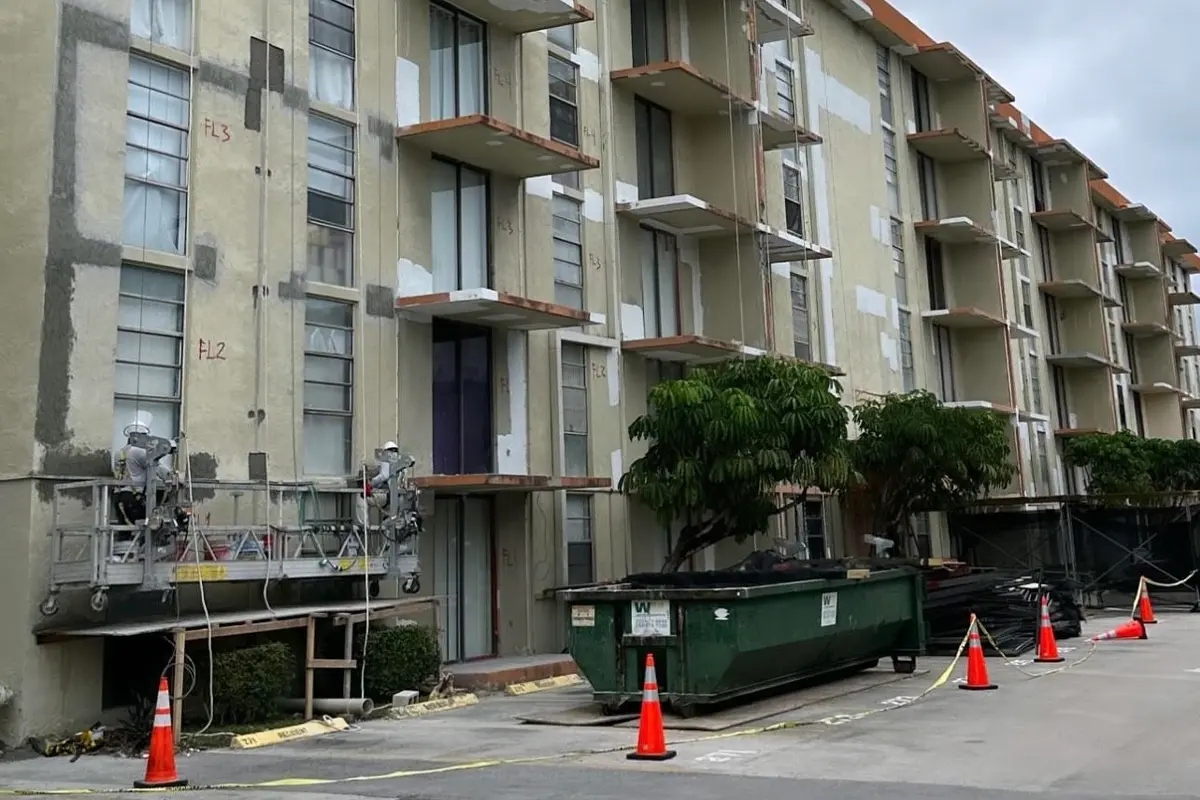



- Spalling concrete repair costs $20–$50 per sq ft for surface damage, $50–$150 once rebar is exposed, and $150–$400+ for structural repairs that need engineering.
- Small residential patches usually land between $300 and $1,000; condo balcony and parking-garage programs routinely run into six figures.
- In South Florida the usual cause is salt-air-driven rebar corrosion — which is why a proper repair treats the steel, not just the surface.
- A patch that skips rebar treatment fails within a couple of years. The 5-step repair sequence is the difference between a $20/sq ft cosmetic fix and a repair that holds.
- Waiting multiplies the bill 5–8×: today's $20–$50/sq ft patch becomes a $150–$400/sq ft structural repair after 2–3 years of neglect.
- Insurance generally won't cover it (gradual deterioration is excluded) — and for condos 3+ stories, spalling is exactly what milestone inspections are designed to catch.
In This Article
Spalling Concrete Repair Cost at a Glance
Spalling concrete repair costs between $20 and $50 per square foot for shallow surface damage, $50 to $150 per square foot once corroded rebar is involved, and $150 to $400+ per square foot for structural repairs that require engineering. Small residential patches often land between $300 and $1,000, while balcony and parking garage restoration programs for condo buildings routinely run into six figures.
That's a wide spread — and it's exactly why two quotes for "the same" spalling repair can differ by thousands of dollars. The price isn't really set by the size of the flaked patch you can see. It's set by what's happening underneath it: how deep the damage goes, whether the steel inside the concrete is rusting, and how much of the structure is affected.
This guide breaks down real spalling repair cost ranges by severity, explains what drives the number up or down, and covers the questions most cost guides skip — insurance, engineering, and what spalling means for Florida condo buildings facing milestone inspections.
| Severity | What you see | Typical cost per sq ft | Typical project total |
|---|---|---|---|
| Surface spalling | Flaking or pitting under 1/2″, no visible steel | $20 – $50 | $100 – $1,000 |
| Moderate spalling | Rust stains, damage 1/2″–1″ deep, rebar partly visible | $50 – $150 | $500 – $15,000 |
| Widespread surface damage | Large areas of shallow spalling | $30 – $80 (overlay) | $3,000 – $40,000 |
| Severe · structural spalling | Exposed, corroding rebar; loose or delaminated concrete | $150 – $400+ | $3,000 – $80,000+ |
Add a professional assessment ($300–$1,500 when a structural engineer is involved) for anything beyond cosmetic flaking. Every building is different — these are industry ranges, and an on-site evaluation is what turns them into a real number.
What Is Spalling Concrete?
Spalling is concrete breaking apart at the surface — flaking, chipping, or pitting that can eventually expose the aggregate or the reinforcing steel inside. You'll also hear the term delamination, which is a related problem: a layer of concrete separating from the sound material beneath it, often hollow-sounding before it breaks loose.
Neither is just cosmetic concrete damage. Spalled concrete is usually the visible symptom of something happening inside the slab or structure — most often moisture issues that have reached the steel.
What Causes Concrete Spalling in South Florida
Most national cost guides blame freeze-thaw cycles and de-icing salts, and in northern climates that's accurate. In Miami-Dade, Broward, and Palm Beach County, the story is different — and it changes what a proper repair costs.
Salt air and rebar corrosion
The dominant cause of spalling in coastal South Florida is chloride-induced corrosion of the reinforcing steel. Salt from ocean air gradually penetrates the concrete. When it reaches the rebar, the steel begins to rust — and rust occupies several times the volume of the original steel. That expansion builds enormous pressure inside the concrete and breaks it apart from within. The flaking you see on a balcony edge or garage column is the concrete literally being pushed off the bar.
This is why coastal spalling is rarely a patch-and-forget job. If the corrosion isn't treated, the same spot fails again — usually within a couple of years.
Water intrusion and failed waterproofing
Concrete is porous. When waterproofing membranes, sealants, or joints fail — on a roof deck, balcony, planter, or pool deck — water carries salt and moisture straight to the steel. Ponding from poor drainage accelerates the process, and water leaks below spalled areas are a common first sign that a deck system has failed.
Construction and material defects
Some spalling traces back to the original pour: too much water in the mix, too little concrete cover over the steel, or finishing done before bleed water escaped. On newer work, widespread flaking is often a workmanship problem — which is worth knowing before you pay anyone to fix it, because warranty claims against the original contractor may apply.
Spalling Concrete Repair Cost by Severity
Surface spalling: $20–$50 per square foot
Shallow flaking with no exposed steel can be repaired by cleaning the area, applying a bonding agent, and patching with a polymer-modified repair mortar, then sealing. Small jobs land between $100 and $1,000 — and in practice, most contractors have a minimum service call around $300–$500 even for a tiny patch. For flatwork like garage floors, simple trowel-applied patching can run as little as $3–$25 per square foot. (For scale: concrete crack repair costs for ordinary sealed cracks run a similar $100–$1,000, so early-stage spalling sits in the same budget class as routine maintenance.)
Moderate spalling with exposed rebar: $50–$150 per square foot
Once rust staining or exposed rebar appears, the job changes. The repair now includes removing all unsound concrete, cleaning the corroded steel, treating it, and rebuilding with structural repair mortar. Typical projects run $500 to $15,000 depending on how many locations are affected.
Widespread shallow damage: concrete resurfacing and overlays
When large areas are spalled, but the damage stays shallow, concrete resurfacing — a bonded concrete overlay of one to two inches, often with corrosion-inhibiting admixtures — can be more economical than dozens of individual patches, at roughly $30–$80 per square foot. Concrete resurfacing also restores a uniform appearance, with decorative finishes available where looks matter — a common choice for pool decks and patios where the surface is as much about appearance as protection.
Severe and structural spalling: $150–$400+ per square foot
Where rebar has lost significant section or concrete is delaminating from structural elements — beams, columns, balcony slabs — repairs require engineering oversight, formwork, sometimes shoring to support the structure during the work, and in the worst cases full replacement of the damaged section. Full concrete replacement of a structural element is the top of the market: $3,000 to $80,000+ depending on scope.
What's Actually in a Spalling Repair (and Why It Costs More Than a Patch)
A proper structural spalling repair is a sequence, not a smear of patch material:
Skip steps two through five, and you get the repair the internet warns about — the patch that "will break again." It's also the difference between a $20-per-square-foot cosmetic fix and a $75-per-square-foot repair that holds. When a low quote is dramatically cheaper than the others, this sequence is usually what's missing.
"A patch over corroding steel isn't a repair — it's a delay. The sequence is what you're paying for: chip it out, clean the steel, treat it, rebuild it, seal it."— New Age Construction Group
What Drives the Price Up or Down
Damage depth and rebar condition. The single biggest factor. Surface flaking is cheap; corroded steel multiplies the scope.
Access and height. A ground-level patio edge is easy. Overhead repairs on garage ceilings, high-rise balcony edges, or facade work involving lifts or swing stages cost substantially more — poor accessibility can double labor. (In one published engineer's estimate, overhead partial-depth patches priced at $200–$350 per square foot versus $75 for the same patch on a horizontal deck.) When you compare quotes, check that each contractor made the same accessibility assumptions — it's one of the most common reasons two numbers don't match.
Engineering, permits, and shoring. Structural repairs in South Florida are permitted work and typically proceed from an engineer's repair protocol. Assessment, drawings, permits, and temporary shoring are real line items on building repairs — and reputable pricing includes them.
Project size and location. Larger repair programs bring per-unit material costs down but add up. Labor rates vary by market; Miami metro pricing sits above national averages.
Holding a spalling repair quote you're not sure about?
Send it to us. We'll walk it line by line — chip-out limits, rebar treatment, coatings, warranty — and tell you what's fair, what's missing, and what you shouldn't be paying for. Free, and no obligation.
Homes vs. Condos and Commercial Buildings
For a single-family home — spalling on a driveway apron, garage slab, pool deck edge, or foundation wall — most repairs fall between a few hundred dollars and a few thousand. Foundation spalling repairs commonly run $1,500–$5,000, with severe structural cases reaching $10,000–$30,000.
Building-scale work is a different category. Published engineering cost opinions for parking garage restoration price the work per unit — and full garage repair programs total seven figures. Condo balcony repair and restoration follows the same logic: unit costs multiplied across dozens of balconies, plus railings, waterproofing, and access.
| Building repair item | Published unit rate |
|---|---|
| Concrete spall repair, deck edges | ~$75 per linear ft |
| Overhead partial-depth patch | $200 – $350 per sq ft |
| Horizontal deck patch | ~$75 per sq ft |
| Epoxy crack injection, structural cracks | ~$100 per linear ft |
| Urethane traffic coating (waterproofing) | ~$6 per sq ft |
If you sit on a condo board, the practical takeaway is that spalling repair is priced per location and per system — which is why a professional concrete restoration assessment that maps every affected area is worth far more than a guess based on one balcony.
The Cost of Waiting
Spalling is progressive. Chloride contamination keeps spreading, rust keeps expanding, and every wet season pushes moisture deeper. The same square foot of damage that costs $20–$50 to patch at first sighting can become a $150–$400 structural repair after two or three years of neglect — a 5–8× escalation, before counting engineering and access costs that small early repairs avoid entirely.
Early repair is the cheapest repair this problem will ever offer.
Deferred spalling also compounds at the portfolio level: what starts as one balcony becomes a building-wide restoration program. Early repair is the cheapest repair this problem will ever offer you.
Is Spalling Concrete Repair Covered by Insurance?
Usually not — and it's worth understanding why. Property policies generally exclude gradual deterioration, corrosion, and wear-and-tear, which is exactly what most spalling is. Coverage can apply when spalling results from a sudden covered event, such as a burst pipe saturating a slab, or impact damage.
Two practical notes: document the damage and its cause with a professional assessment before filing anything, and if the spalling is on recent construction, a workmanship warranty claim against the original contractor may be a better path than insurance. Review your specific policy — this is general information, not coverage advice.
Spalling and Florida's Building Safety Rules
For condo and co-op buildings three stories or taller, spalling isn't just a maintenance question — it's a compliance one. Florida's milestone inspection law (SB 4-D) requires a structural inspection at 30 years (25 for buildings near the coast) and every 10 years after. In Miami-Dade and Broward, the 40-year recertification program applies as well, and Structural Integrity Reserve Studies now require boards to fund concrete repairs rather than defer them.
Spalling is exactly what inspectors are looking for
Milestone inspections and 40-year recertification reviews are designed to catch spalling and delamination. A visible spall on a 3+ story building isn't just a repair line item — it's a finding waiting to happen. Boards that repair before the inspection consistently pay less.
Spalling and delamination are precisely what these inspections are designed to catch. Boards that budget for structural repair proactively — rather than discovering the scope during a milestone inspection — consistently pay less, because early-stage repairs are smaller, need less shoring and access work, and can be phased sensibly.
DIY vs. Hiring a Professional
DIY is reasonable for one narrow case: shallow, dry, cosmetic flaking on flatwork — no rust stains, no exposed steel, no moisture. Patch material costs are modest, and crack sealing hairline cracks with caulk or filler is a legitimate weekend job that helps keep water out.
Everything else belongs with a licensed contractor. Patching over corroding steel traps the problem and wastes the money, and DIY structural repair isn't lawful or safe on multifamily buildings. Note also that spalling repair is its own trade: concrete leveling, mudjacking, and polyurethane foam injection fix sunken slabs and uneven surfaces, which is a different problem with different pricing — if your slab has settled rather than spalled, get a concrete leveling quote instead. A leveling crew isn't the right hire for corrosion damage, and vice versa.
When You Need an Engineer (and What an Assessment Costs)
Bring in a structural engineer when spalling appears on structural elements (balconies, columns, beams, garage decks), when it's widespread, when concrete is delaminating in sheets, or any time a building over three stories is involved. Expect $300–$1,500 for an engineering assessment; many contractors, New Age included, provide free initial evaluations and coordinate engineering when the scope requires it.
Get more than one estimate for significant work, compare scope line by line — chip-out limits, rebar treatment, anodes, coatings, shoring — and ask what warranty backs the repair. The cheapest number attached to the thinnest scope is usually the most expensive choice on a five-year horizon.
Seeing flaking concrete, rust stains, or exposed steel on your property? New Age Construction Group is a state-certified general contractor (CGC #1531273), fully insured and bonded, specializing in concrete restoration across Miami-Dade, Broward, and Palm Beach County — from single homes to high-rise balconies and parking garages. Request a free assessment and get a repair scope you can actually compare quotes against.
- 1Budget by severity tier: $20–$50/sq ft for surface patching, $50–$150 with exposed rebar, $150–$400+ for structural work — and $300–$1,000 for most small residential jobs.
- 2Judge quotes by scope, not the bottom number: chip-out limits, rebar cleaning and treatment, galvanic anodes, structural mortar, and protective sealing are what make a repair hold.
- 3Repair early — the same damage costs 5–8× more after 2–3 years of neglect, before counting the engineering and access costs that early repairs avoid.
- 4Buildings price per location and per system: balcony and garage programs are unit rates multiplied across the structure, so a mapped assessment beats any per-square-foot guess.
- 5DIY only fits shallow, dry cosmetic flaking. Rust stains or exposed steel mean a licensed contractor — and on 3+ story buildings, an engineer.
- 6Don't count on insurance: gradual deterioration is excluded. For Florida condos, treat spalling as a milestone-inspection and 40-year recertification issue and get ahead of it.

Stephanie Lopez
Owner, New Age Construction Group
Stephanie Lopez is the owner of New Age Construction Group, a state-licensed structural restoration contractor (CGC#1531273) serving Miami-Dade, Broward, and Palm Beach County. She leads the firm's concrete restoration, waterproofing, post-tensioning, and 40-year recertification work for condominiums, HOAs, and commercial properties across South Florida.
View Full Profile →