



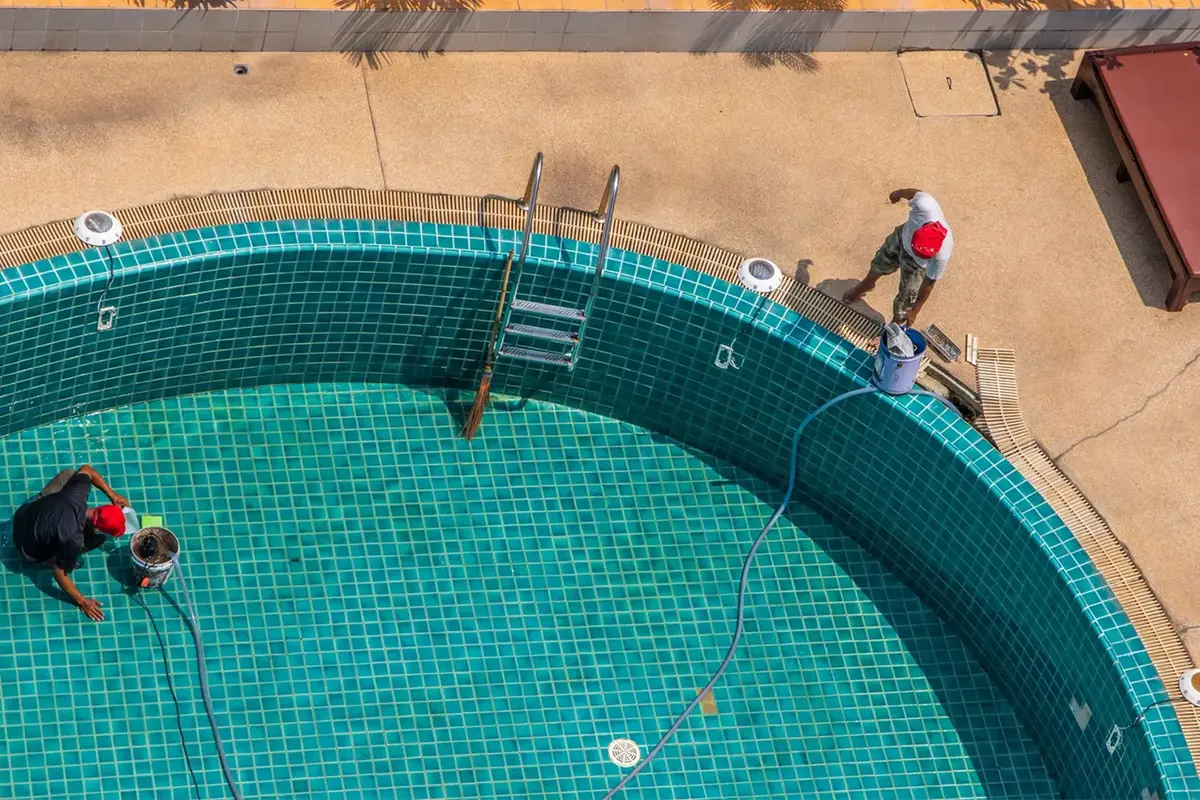
- Resurfacing, replastering and tile work address the finish. Structural repair addresses the shell, the bond beam, the steel inside them, and the soil and footing that support them.
- A crack is structural when it penetrates the shell rather than stopping in the finish, when the pool loses water through it, or when it moves over time.
- Sinkholes are a central Florida problem; in South Florida, a sinking pool almost always traces back to washout or compaction.
- Repairing cracks on a pool that is still moving guarantees you will repair them again.
- A contractor proposing structural work without a permit is a warning sign, not a cost saving.
In This Article
Most calls about pool structural repair in Florida start the same way. A pool maintenance crew notices the water level dropping faster than evaporation can explain, or a resident points out a crack that was not there last season. The board asks the property manager what it means, and the answers that come back from swimming pool repair companies range from "patch it and replaster" to "you need a new pool."
The answer is usually somewhere in between, and finding it means treating the pool as what it is: a reinforced concrete structure, often tied directly into the building around it.
New Age Construction Group is a state certified general contractor (CGC#1531273) that restores concrete structures across Miami and South Florida, including pool shells, decks and the slabs beneath them.
What Counts as Structural (and What Is Just Resurfacing)
A concrete inground swimming pool has two very different layers. The finish you see, usually plaster, pebble or tile, is a wear surface roughly half an inch thick. Underneath is the structure: a shell of gunite or shotcrete (the dry mix and wet mix forms of sprayed concrete), typically six to ten inches thick, reinforced with a grid of reinforcing steel and topped by a bond beam that stiffens the perimeter and carries the coping (the cap at the pool edge) and the deck. Beneath all of it is the footing and subgrade, which on rooftop and podium pools (pools built over parking or occupied floors) is the building's own slab and beams. A fiberglass pool is built differently, with a laminated shell that fails by delamination (the layers separating from each other); this guide is about concrete pools.
Resurfacing, replastering and tile work address the finish. Structural repair addresses the shell, the bond beam, the steel inside them, and the soil and footing that support them. The two look similar from the deck and are priced and permitted very differently, which is why pool remodeling quotes and structural quotes for the same pool can be far apart.
Surface cracks and other surface damage live in the finish: a web of fine lines that does not leak and is a finish job. Structural cracks pass through the finish into the shell and often all the way through it. They leak, and they call for structural pool crack repair rather than a cosmetic patch.
How to Tell If a Pool Crack Is Structural
Boards rarely have an engineer on staff, and most swimming pool repair quotes do not include one, so it helps to know what structural damage looks like before you commission an assessment.
Signs in the shell
Hairline cracks confined to the finish are common. A crack you can fit a coin edge into, or one that exposes darker concrete beneath the finish, has probably reached the structure. Diagonal cracks running from corners or from where the wall meets the floor usually point to settlement, while long straight cracks along construction joints or the bond beam suggest restraint or ground movement. Cracks that open and close with water level or temperature, or that have grown between inspections, are active and need to be stabilized before they are filled.
Signs outside the shell
- Water loss beyond normal evaporation, which in South Florida summers is roughly a quarter inch a day. Daily topping off usually means something is leaking, and plumbing leaks have to be ruled out before the shell is blamed.
- Rust staining bleeding through the finish, which can mean the reinforcing steel is wet and corroding, once metal debris and iron in fill water are ruled out.
- Tile and coping displacement, hollow sounding areas where the finish has separated from the shell, or a bond beam that has shifted away from the deck.
- Step, bench or floor movement underfoot, or sunken soil, settled pavers and voids beneath the deck around the pool.
- Cracks around the skimmer throat, lights and return fittings that keep reopening after patching.
How do I know if my pool crack is structural?
A crack is structural when it penetrates the shell rather than stopping in the finish, when the pool loses water through it, or when it moves over time. Rust stains, displaced tile or coping and sunken deck areas nearby are confirming signs. A structural assessment with leak detection settles it.
Why Pool Shells Crack and Settle in South Florida
National articles about pool cracks talk about frost and hillsides. Neither applies here. South Florida has its own set of causes, and the repair has to match them.
Sandy soils and differential settlement
Much of Miami-Dade, Broward and Palm Beach sits on sand and fill over limestone, and bearing capacity varies from one lot to the next. If one end of the shell settles faster than the other, the shell bends in a way it was never designed to, and diagonal cracks appear. Poor compaction during the original build, washouts from a long-running leak, or a utility trench nearby are the usual triggers. Sinkholes are a central Florida problem; in South Florida, a sinking pool almost always traces back to washout or compaction.
High water table and hydrostatic pressure
The water table in coastal South Florida can sit within a few feet of the surface in the wet season. Groundwater pushes on the outside of an empty or partly drained shell, and that hydrostatic pressure can crack it or lift it out of the ground. Every drained repair has to control groundwater first, usually through a working hydrostatic relief valve (a one-way valve in the main drain that lets groundwater in instead of lifting the shell) and dewatering.
Salt air, chlorides and rebar corrosion
This is the failure mode we see most often on older coastal buildings in Miami Beach, Fort Lauderdale and along the Palm Beach barrier island. Chlorides from salt air and from pool water migrate through the concrete to the steel. The steel corrodes, expands and spalls the concrete around it. Spalling in a shell or bond beam is a loss of section in the structure. The same chemistry drives balcony and parking garage deterioration, and the same corrosion control and spalling concrete repair methods apply.
Heat, age, construction defects and site conditions
Decades of daily thermal expansion and contraction can turn hairline cracks into through cracks at corners, steps and the bond beam. A shell shot too thin, rebound material (the dry overspray that falls during shooting) packed back into the shell, steel placed too close to the surface, and missing expansion joints between pool and deck all show up as structural issues years later. Pull the original pool builder's drawings before the assessment if they exist. Ficus and oak roots widen small cracks, and downspouts beside the pool saturate the subgrade.
Cracked Pool Shell Inspection: What a Structural Assessment Includes
A proper assessment answers three questions: where is the water going, how deep does the damage go, and why did it happen. Most pool repair services stop at the first question.
Leak confirmation
A bucket test compares water loss to evaporation over 24 hours. Dye testing at cracks, the skimmer, lights and fittings shows where water is actually leaving. Pressure testing of suction and return lines separates plumbing leaks from shell leaks. Electronic leak detection locates leaks through the deck and soil without demolition. Done in this order, pool leak detection prevents the most expensive mistake in the field: fixing a shell crack when a pipe was the problem.
Looking behind the finish
Every visible crack is photographed and recorded by location, length, width and direction. Sounding the pool surface with a hammer finds hollow, delaminated areas. A borescope (a small camera probe) or small cores confirm crack depth and shell thickness. A corrosion survey tells the engineer how much of the steel is compromised. Because settlement cracks are not fixed by filling them, the assessment also reviews soil, groundwater, drainage and any history of leaks that may have washed out the subgrade.
The engineer's report
For a condominium or commercial pool, the output should be a report from a Florida licensed professional engineer with structural experience: findings, a classification of each defect, a repair design and a scope the board can bid out. It also becomes the basis for the building permit.
Pool Structural Repair Methods, Matched to the Failure
There is no single fix. Each method addresses a specific failure, and most real projects combine two or three.
Injection. Epoxy fills a crack from the inside out and cures harder than the surrounding concrete, but it is rigid, so it only belongs on cracks that have stopped moving. Polyurethane stays flexible and is the better choice for leaking cracks that may still move slightly. Hydraulic cement, the quick patch, stops water temporarily and rarely holds. See our epoxy injection crack repair guide.
Stitching and staples. Steel staples or carbon fiber stitches are set in saw cuts across the crack and bonded with structural epoxy to restrain the crack from reopening. Carbon fiber adds strength without adding thickness. See our guide to carbon fiber concrete repair.
Spall remediation. Unsound concrete is removed to expose the corroded steel, the bars are cleaned, treated or replaced, and the section is rebuilt with repair mortar. On coastal pools this is often the real scope behind a few cosmetic looking cracks, and it is core concrete restoration work.
Inner shell. When the existing shell is too thin, weak or far gone for localized pool crack repair, a new reinforced shotcrete shell is sprayed inside it. The pool loses a few inches of interior dimension and can add decades of service life.
Bond beam and settlement. A failed bond beam is removed and recast with new steel, then the coping and the joint between pool and deck are rebuilt. If the subgrade is the problem, piers driven to competent soil or grouting beneath the shell come first. Repairing cracks on a pool that is still moving guarantees you will repair them again.
Waterproofing and finish come last. Once the structure is sound, the shell is waterproofed and the finish restored. Where the pool sits over occupied space, commercial waterproofing of the shell and deck is part of the structural scope.
Permits, Licensing and Engineering in Miami-Dade, Broward and Palm Beach
This is the part most guides skip, and it is where boards get into trouble.
When a permit is required. Under the Florida Building Code, repairs that alter, reinforce or reconstruct the shell or bond beam require a building permit from the local building department. Resurfacing is not automatically exempt: public pools generally need a permit for a new finish and some South Florida building departments require one for residential pools, so confirm before any finish work. A contractor proposing structural work without a permit is a warning sign, not a cost saving.
Who can do the work. Structural work must be performed by a licensed contractor whose license covers that scope, verified with the Florida Department of Business and Professional Regulation before any contract is signed. For work that ties into the building, a licensed general contractor with concrete restoration experience is usually the right fit, rather than a swimming pool repair company built around equipment and finishes.
Engineer sealed plans. A permit for structural work will usually require drawings sealed by a Florida licensed engineer. Beyond the permit, the sealed design protects the board: it defines the scope, gives bidders the same basis, and creates documentation a reserve study, insurer or buyer will ask for.
Public pools. Pools serving condominiums, hotels and commercial properties are generally classified as public pools regulated by the Florida Department of Health, with limited exemptions for small associations. Structural work almost always means closing the pool, and reopening may require a health department inspection in addition to the building department's final.
Timelines. Permit processing in Miami and other busy South Florida jurisdictions can take several weeks, and engineering, permitting and procurement often take longer than the repair itself. If your board needs the scope defined before bidding, contact us and we will coordinate the assessment with a licensed engineer.
Repair, Stabilize or Rebuild? A Decision Framework
Pool structural repair by injection or stitching is enough when the shell is sound, the steel is not corroding, the cause has been identified and stopped, and the cracks are few. The shell or bond beam has to be rebuilt when spalling is widespread, the steel has lost significant section, or the beam has failed around much of the perimeter; localized pool repair chases the problem, and an inner shell or beam reconstruction addresses the cause. Settlement has to be fixed first whenever diagonal cracking is tied to movement, deck areas have sunk or the waterline is out of level. Stabilize, then repair.
What Pool Structural Repair Costs in Florida
Pool crack repair cost depends on what the assessment finds, which is why pool repair services cannot price it over the phone. The useful thing to understand is what drives the number.
- 1Extent and method. Injection and stitching are priced per linear foot, spall repair per square foot, rebuilds and inner shells by the job. Injection is the least expensive, inner shells the most.
- 2Access and dewatering. Draining, controlling groundwater and protecting the deck add cost on every South Florida job.
- 3Engineering, permits and finish. Engineering fees, sealed drawings and permit costs are a real line item on commercial work, and structural work almost always means a new finish afterward.
- 4Downtime. For a shared amenity, closure length is a cost the board feels even when it is not on the invoice.
Published swimming pool repair estimates from national contractors and cost guides give a sense of scale: roughly $250 to $350 per linear foot for stitching, $1,000 to $3,000 or more to staple a single crack, $3,000 to $8,000 for a professional pool crack repair compared with $15,000 to $40,000 for a full renovation, and $15,000 to $25,000 for an inner shell. These are residential figures from other contractors, not New Age pricing. Commercial pools with deeper shells, corrosion damage and permit requirements typically run above these residential ranges.
What Condo Boards and Property Managers Should Plan For
Pool structural repair on a shared amenity is a board decision as much as a construction one.
Fix the system, not the crack. On most South Florida buildings the shell, the pool deck slab, the expansion joints between them and the waterproofing beneath are one system. A crack in the shell often shares a cause with the spalling deck or the leak into the garage below. Scoping them together through pool deck repair and expansion joint repair avoids mobilizing twice.
Plan the closure. A typical commercial sequence runs assessment, engineer's report, permit, dewatering, repair and cure, inspections and leak verification, waterproofing and finish, refill, then health department reopening where required. Minor structural repairs take days once permitted; larger scopes run one to several weeks of construction, with engineering and permitting adding weeks before that. Give residents a window that includes all of it, post the scope and the reason, and ask the contractor for a warranty that covers the structural work as well as the finish.
Keep the documentation. A leaking or structurally compromised public pool is a liability exposure. Keep the assessment, engineer's report, permit and final inspection records together; insurers, lenders and buyers will ask for them.
Connect it to reserves and recertification. Florida's structural integrity reserve study requirements and the milestone inspection program have made boards far more aware of concrete deterioration, and a documented pool and deck repair belongs in the same file as structural integrity reserve study planning and 40-year recertification records in Miami-Dade and Broward.
Frequently Asked Questions
Get a Structural Assessment of Your Pool
If your pool is losing water, showing structural cracks or rust staining, or sitting on a deck that has started to settle, the first step is an assessment, not a resurfacing quote. New Age Construction Group coordinates structural assessments with licensed engineers and performs permitted pool structural repair for condominiums, HOAs and commercial properties across Miami-Dade, Broward and Palm Beach County. The first visit is free: we walk the pool and deck, tell you whether what you are seeing is cosmetic or structural, and scope the engineer's assessment if one is warranted. We are a state certified general contractor (CGC#1531273), fully insured and bonded, with OSHA certified crews and more than 500 structures restored, and our pool repair services cover the shell, bond beam, deck and waterproofing together: one contractor, one scope, one point of accountability.
Schedule a free assessment or call (786) 786-1006. You can also read more about our structural repair services.