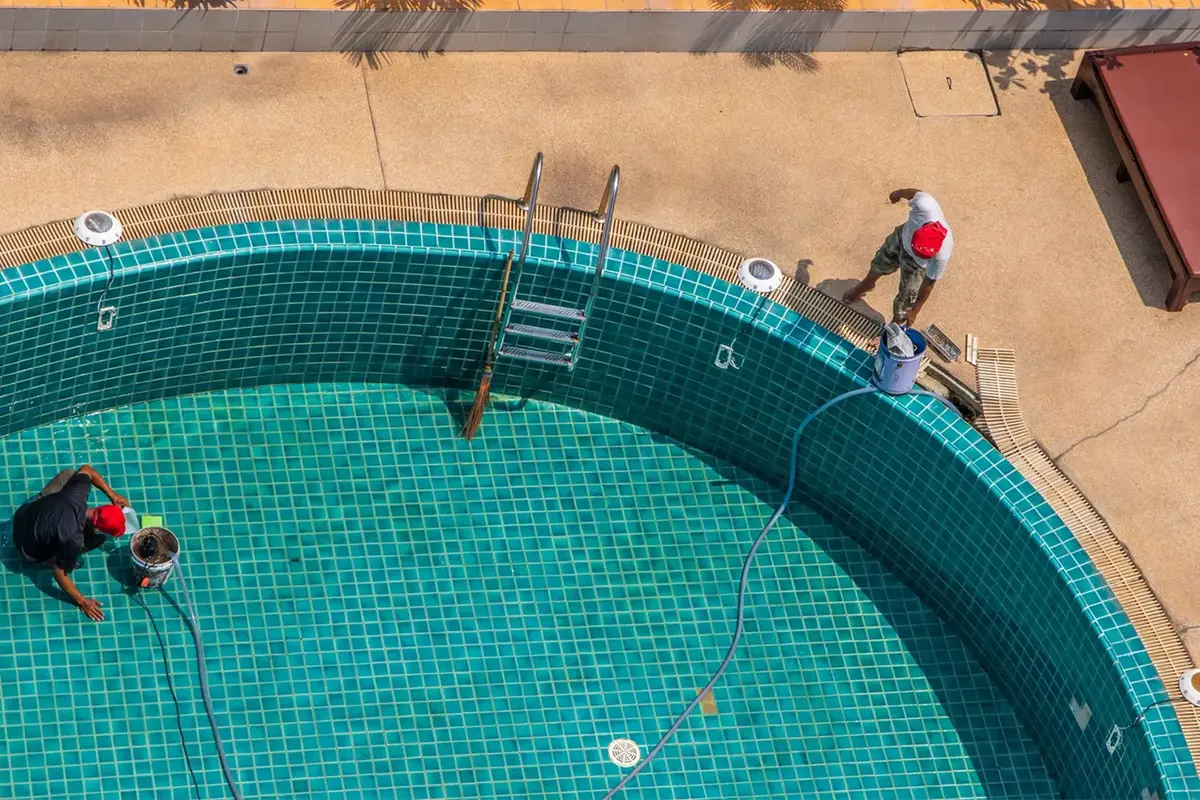




- On an elevated pool deck built over a parking garage or amenity level, it lands on a waterproofing membrane. When that layer fails, water reaches the structural slab, the steel and whatever is parked underneath.
- Every condo deck project comes down to one question: is the problem in the surface, in the slab, or in the membrane between them?
- Boards that bid a defined scope get comparable numbers; boards that ask three contractors to look at the deck get three different projects.
- A deck membrane has a service life, and a SIRS puts that life on a schedule with a dollar figure attached.
- Match the license to the scope.
In This Article
Most condo pool deck problems in Miami start as a cosmetic complaint: a crack, a section that rocks underfoot, a slick patch near the steps. Then the property manager finds a water stain on the garage ceiling under the pool, or a milestone inspection report lists the deck as a structural concern, and the board realizes the deck is part of the building.
This guide covers the warning signs, the repair versus replace decision, elevated decks over garages, permits, cost, and how to keep residents informed, for associations in Miami-Dade, Broward and Palm Beach counties. New Age Construction Group is a state certified general contractor (CGC#1531273) that restores decks for condominiums, HOAs and apartment complexes across South Florida, and this is a conversation we have with boards regularly.
Why condo pool decks in Miami fail faster than the rest of the building
Salt air, UV, foot traffic and pool chemicals
Salt air and saltwater pool systems push chlorides into the concrete, where they attack the reinforcing steel. UV exposure breaks down sealers and pool deck coatings long before the surface shows it. Miami highs stay above 80 degrees for nine months of the year, so the deck expands and contracts daily, opening fine cracks and widening old ones. Add hundreds of residents, dragged furniture and daily splash-out carrying pool chemicals onto the surface, and a condo deck ages far faster than a backyard one.
Elevated decks give water somewhere to go
On a deck built on grade, water that gets through the surface ends up in the soil. On an elevated pool deck built over a parking garage or amenity level, it lands on a waterproofing membrane. When that layer fails, water reaches the structural slab, the steel and whatever is parked underneath. That is the biggest difference between condo work and residential work.
Warning signs your pool deck needs repair, not just maintenance
Routine maintenance means pressure washing, resealing and replacing joint sand. The signs below mean something underneath has changed.
Cracks and what their width tells you
Hairline cracks under an eighth of an inch are usually shrinkage or thermal movement and can be sealed. Cracks wider than a quarter inch, or cracks with one side higher than the other, point to substrate movement or structural stress and need an engineer's opinion first.
Spalling and exposed rebar
Spalling is concrete flaking or breaking away in chunks because the steel inside has rusted and expanded, pushing the concrete off from within. Visible rebar means the deterioration has been underway for years. Our guide to spalled concrete covers the repair.
Delamination and hollow sounding coatings
Delamination is a layer separating from the layer beneath it, whether a coating lifting off the concrete or a top layer of concrete separating from the slab. Drag a chain across the deck; hollow spots sound different. Delamination spreads long before it shows.
Settlement, uneven pavers and trip points
Pavers that rock, a slab that has dropped at one corner, or a lip between two sections mean the base has washed out. On grade, that is usually soil erosion or a plumbing leak feeding voids under the slab, and South Florida's limestone rich soil compresses unevenly after heavy rain. On an elevated deck, it can mean the setting bed or the membrane beneath it has failed.
Ponding water, drainage and coping
The deck is built with a drainage slope that carries water to deck drains; puddles that sit for hours mean the slope has shifted or the drains are blocked. Pool coping is the cap at the pool edge. Coping that separates from the deck or the bond beam lets water behind the pool wall, and coping replacement that changes the deck surface requires a permit in Miami-Dade.
Leaks, stains or dripping in the garage below
Rust stains on the garage ceiling, efflorescence (white mineral deposits), dripping after rain, or water running down columns under the pool mean the membrane has failed and the structural slab is wet. Treat this as urgent.
Repair, resurface or replace: how the decision gets made
Every condo deck project comes down to one question: is the problem in the surface, in the slab, or in the membrane between them? Boards most often ask whether to resurface a pool deck or replace it. This is how contractors and engineers sort the options.
| Condition | Usual action | Permit | Engineer | What drives the cost |
|---|---|---|---|---|
| Hairline cracks, faded or worn surface | Crack repair, cleaning, resealing | No | No | Square footage |
| Worn coating, minor lifting, slippery surface | Resurfacing with a new slip-resistant coating or overlay | Usually no | No | Surface preparation, finish |
| Cracks over 1/4 inch, flaking concrete, displacement | Structural repair (epoxy injection, concrete patching, rebar treatment), then resurface | Yes | Yes | Extent of concrete repair |
| Settlement or voids under a slab on grade | Slab lifting with polyurethane foam or base repair, then resurface | Yes | Often | Volume of voids |
| Leaks below an elevated deck | Remove finish, repair slab, replace membrane, reinstall finish | Yes | Yes | Demolition, membrane, phasing |
| Failed slab or widespread structural damage | Full deck replacement | Yes | Yes | Demolition and structural scope |
When sealing or spot repair is enough
If the deck is structurally sound and the problems are cosmetic, crack repair and a fresh sealer are the right call. In coastal South Florida, published guidance is to reseal every 12 to 24 months rather than the two to three years that works inland.
When resurfacing makes sense (and when it is wasted money)
Pool deck resurfacing puts a new wear layer over sound concrete: a spray texture, a cool deck coating (Kool Deck is one brand), a stamped concrete overlay, an exposed aggregate finish, or new pavers over the existing slab. It restores traction and appearance at a fraction of the cost of replacement. A resurfaced deck typically lasts 8 to 15 years, and acrylic and cool deck coatings need a recoat every 3 to 5 years. Concrete resurfacing is wasted money when the slab is moving, when moisture is coming up through the concrete, or when the membrane on an elevated deck has failed; a new pool deck coating over a leaking deck lifts within a season. Our post on pool deck resurfacing covers the finish options.
When the slab or membrane has to come out
Full deck replacement is the answer when the concrete slab itself has failed, when rebar corrosion is widespread, or when an elevated deck's membrane must be replaced and the finish cannot be salvaged. See what goes into pool deck replacement before a bid lands on your desk.
If the deck shows any of the structural signs above, the next step is an engineering assessment, not a coating quote. New Age's condo pool deck repair services start with a free on-site assessment so the board can compare bids on a defined scope.
Elevated pool decks over parking garages: the condo specific problem
Many Miami condos put the pool on a podium deck above the parking garage or an amenity level. That makes the deck a roof.
Structural slab vs slab on grade
A slab on grade sits on compacted soil and can be lifted, patched or replaced without affecting anything else. A structural slab spans between beams and columns, carries the pool, the water, the finish and everyone on it, and transfers that load into the building frame. Any concrete repair on it is building structure work, which is why it needs a permit and, in practice, an engineer.
The waterproofing membrane and why it fails
Between the structural slab and the finish sits a waterproofing membrane, usually a fluid applied or sheet system under a drainage layer and setting bed. It fails at seams, at penetrations like drains and light conduits, at the pool wall, and wherever the finish was cut or patched without sealing it again. Commercial waterproofing on an elevated deck is a structural protection system, not a coating.
Post tension cables, beams and columns
Post-tension construction uses steel cables tensioned inside the slab to carry loads with less concrete, and it is common in South Florida podium decks. Water that corrodes a post-tension cable weakens the slab in a way a patch cannot fix, and cutting into the slab without locating the cables is dangerous. Post-tension cable repair is specialized work, as is reconstructing a pool beam or jacketing piles and columns that have lost section to corrosion. If your deck doubles as the garage roof, parking garage repair and the deck above it are one project viewed from below and above.
Expansion joints, drains and planters
Expansion joints let the deck move without cracking; when their sealant fails they become the primary leak path, with drains and planters close behind because they punch through the membrane. Expansion joint repair is often the first scope item on an elevated deck.
What the project looks like, step by step
Engineering assessment and testing
A structural engineer or qualified contractor sounds the concrete for hollow spots, measures crack widths, checks the drainage slope, and on elevated decks inspects the garage ceiling below. Core samples, chloride testing and moisture readings may follow. The written assessment separates what is cosmetic, what is structural and what is a membrane problem.
Scope, bids and the permit
The assessment becomes a scope of work: repair quantities, membrane system, finish, slip-resistant coating requirements. Boards that bid a defined scope get comparable numbers; boards that ask three contractors to look at the deck get three different projects. Structural work, slab lifting, membrane replacement on an elevated deck, drainage changes and coping replacement then require a permit from the Miami-Dade Building Department or your city's building department.
Demolition, concrete repair, waterproofing and finish
The crew removes the finish and setting bed, chips out deteriorated concrete to sound material, cleans and treats the steel, fills structural cracks, places repair mortar, installs the new membrane with the engineer's sign-off at each stage, and rebuilds the finish. Surface preparation on a recoating job matters just as much: the existing surface is shot blasted or ground, not just pressure washed, so the new coating bonds.
Inspections, close out, warranties and timeline
The building department inspects at permit milestones and issues a final; the engineer provides a close-out letter. Get the membrane manufacturer's warranty and the contractor's workmanship warranty in writing, with the maintenance that keeps them valid. A recoating job on a sound slab takes days to a couple of weeks depending on deck size, prep and cure times. A structural job with membrane replacement on an elevated deck runs weeks to months depending on how much concrete repair appears once the finish comes off. Build that uncertainty into the budget before the board votes.
Permits, codes and inspections for condo pool decks in Miami
Florida Building Code and the county building department
The Florida Building Code governs deck slope, drainage and the structure beneath. Maintenance such as cleaning, sealing and joint sand replacement needs no permit. Structural cracks over a quarter inch, slab lifting, full replacement, drainage grade changes and coping replacement that alters the deck plane do. For structural scope the building department typically requires engineer sealed drawings, and that engineer of record inspects the repairs at defined stages. Broward and Palm Beach counties follow the same Florida Building Code through their own permitting offices.
Florida Department of Health rules for association pools
Most condominium and HOA pools are regulated as public pools by the Florida Department of Health under Chapter 64E-9 of the Florida Administrative Code. The deck is part of what the health inspector checks, and a trip or slip safety hazard can get a pool closed. Commercial pool deck surfaces are also expected to meet wet slip resistance and accessibility standards residential decks are not held to: the ANSI A137.1 wet DCOF threshold of 0.42 is the reference for commercial pools, and ADA applies to public decks.
Who is allowed to do structural deck work
Structural repair in Florida requires a contractor licensed through the Florida Department of Business and Professional Regulation (DBPR). A certified pool/spa contractor is licensed for the pool and its deck finish. The structural slab, beams, columns and garage beneath an elevated deck are building structure, which falls under a certified general contractor's license. A pool renovation company and a structural contractor are doing different jobs, and the scope decides which one you need.
How milestone inspections and SIRS tie in
Condos three stories and taller face milestone inspections in Florida starting at 30 years (25 where the local building official requires it for coastal buildings) and every ten years after, and in our experience an elevated deck is one of the most common places inspectors find deterioration. The same buildings must fund a structural integrity reserve study, and because waterproofing and structural components are SIRS items, the deck membrane and slab typically belong in the reserve schedule.
What it costs to repair a condo pool deck in South Florida
On grade, published South Florida ranges run $2 to $6 per square foot for minor repairs, $4 to $15 for resurfacing and $15 to $25 for full replacement. Elevated condo decks run higher, and nothing below replaces an assessment.
Cosmetic resurfacing
Pool deck resurfacing is quoted per square foot: spray texture about $4 to $7, cool deck coatings $5 to $9, stamped concrete overlays $7 to $12, and marine grade coastal coating systems $10 to $15 or more. Minor crack repair, spall patching and resealing run $2 to $6 per square foot. Our pool deck resurfacing cost guide breaks these down by finish.
Full replacement and what drives a condo price
Concrete pool deck resurfacing prices assume the slab is sound. Tearing out and replacing a deck on grade runs $15 to $25 per square foot, roughly three to four times a new surface, and on an elevated deck demolition over an occupied garage, structural scope and a new membrane system put the cost well above that. Once the scope includes chipping out deteriorated concrete, treating rebar and crack injection, the only honest estimate comes from an engineering assessment with allowances for hidden damage. Five things move a condo deck estimate more than the finish: whether the deck is elevated, how much concrete repair appears once the finish is removed, membrane replacement, access (crane time, protecting cars below, limited hours), and phasing to keep part of the pool area open.
Reserves, SIRS and special assessments
A deck membrane has a service life, and a SIRS puts that life on a schedule with a dollar figure attached. Boards that fund it through reserves repair on their timeline. Boards that wait for the garage to leak repair on the building's timeline, usually through a special assessment. Read what a SIRS costs and ask for a free assessment, so the reserve specialist has a scoped repair estimate to work with instead of a published range.
Keeping the pool open and residents informed
Larger decks can be phased into zones so part of the pool area stays usable, at some added cost and time. Membrane replacement, structural work around the pool shell and coping work generally require closing the pool, and a deck under construction will not pass a health department inspection, so plan the closure for the off season where possible. Owners accept a closed pool when they understand the garage ceiling is the same slab they sunbathe on: share the engineer's findings, the scope, the schedule and the funding plan in plain language before work starts, and send updates when hidden condition quantities come in.
Choosing a contractor for an association deck project
Match the license to the scope. Surface work on a sound deck can go to a pool renovation or coating specialist. Anything involving the slab, the membrane, post-tension cables or the garage below needs a licensed contractor holding a general contractor's license, with structural experience on occupied condo buildings. Ask for the certificate of insurance naming the association, confirm the contractor has worked under an engineer of record on permitted structural repairs, and call references at other condo associations and apartment complexes in South Florida.
Before you sign, ask:
- Who is the engineer of record, and who pulls the permit?
- What allowance covers hidden concrete repair, and how are quantities verified?
- Which membrane system is specified, and what is its warranty?
- How will cars and residents below be protected?
- What is the phasing plan and the pool closure schedule?
- What maintenance keeps the warranty valid?
Frequently asked questions from condo boards
Schedule a free assessment
New Age Construction Group restores decks for condo associations, HOAs and commercial properties across Miami-Dade, Broward and Palm Beach counties. We are a state certified general contractor (CGC#1531273), licensed and insured, with OSHA certified crews, more than 500 structures restored and a 4.9 Google rating from 50+ reviews. If your deck shows any of the warning signs above, schedule a free deck assessment or call (786) 786-1006.